What Is The Disadvantage Of A Catamaran?
An honest look at the real disadvantages of catamarans, from wind-driven motion and docking to cost, and who should still book one in Tamarindo.
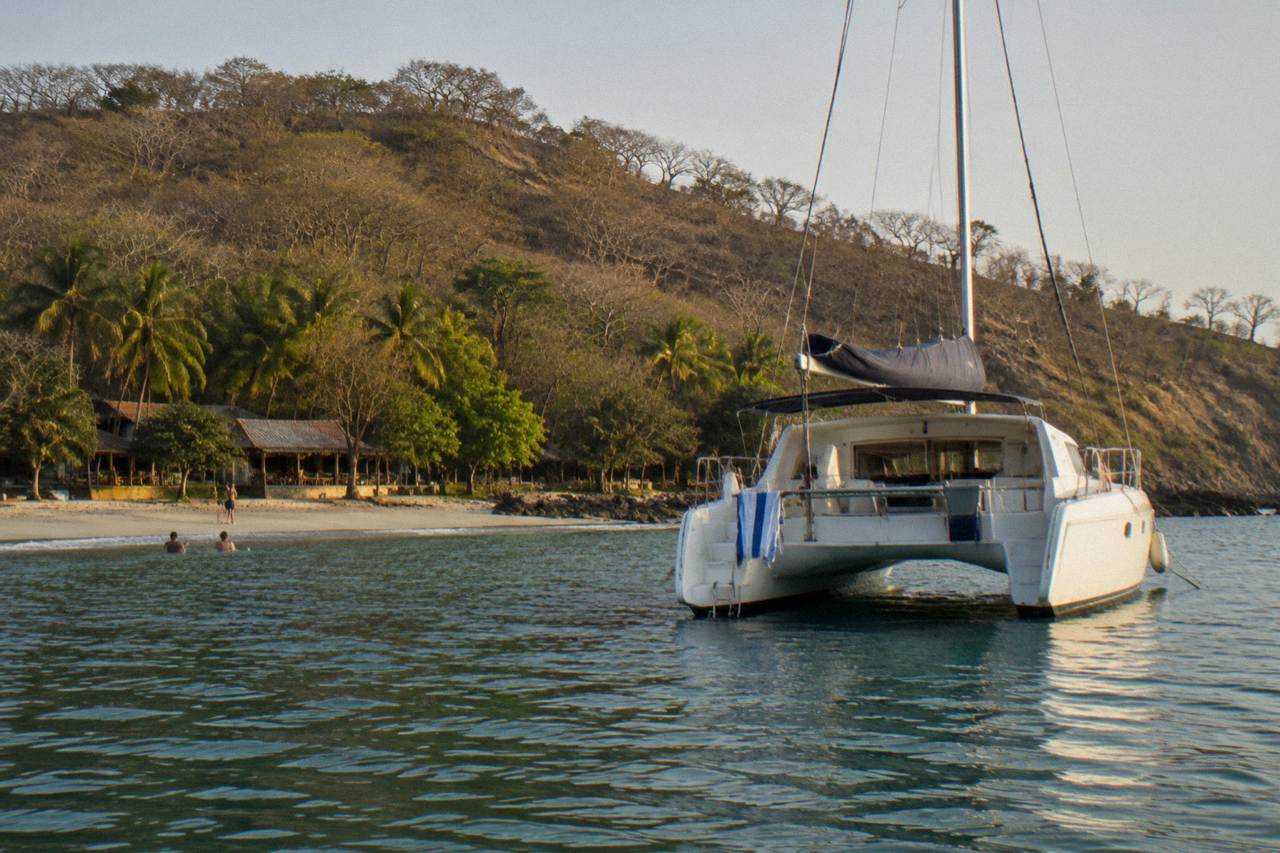
The main disadvantages of a catamaran are quicker, shallower motion when swell or wind hits the beam, more windage that makes docking and maneuvering under power harder, higher cost per hour than a similar-length monohull, and a wide deck layout that puts everyone out in the elements rather than sheltered in a deep hull. For a five-hour cruise out of Tamarindo, none of these are dealbreakers, but each one shapes what your day on the water actually feels like.
Most of the trips leaving from the El Chiringuito area of Tamarindo beach are catamarans, and this site exists because they are the standard vessel for sunset sails, snorkel stops and coastal cruising here. That does not mean the design is without critics. Sailors have argued the catamaran versus monohull question for decades, and the drawbacks the critics raise are real, they are just usually outweighed on a short coastal tour by the two huge advantages: a stable platform that does not heel, and deck space for twenty or more guests to eat, swim and watch the sunset without climbing over each other.
This article walks through the genuine downsides in plain terms. Where a fact comes from an official source, a coast-guard guidance note or published weather data, it is linked. Where it comes from the tour listings themselves, these listings are the source, with prices and ratings exactly as listed.
Why Do Catamarans Roll More In Beam Seas?
A catamaran's two narrow hulls bridge across wave crests instead of riding them, so when swell arrives from the side, the whole boat snaps level-to-level in a quick, shallow roll rather than the slow lean of a monohull. People prone to seasickness often report this short-period motion, sometimes called a "cork" or snap roll, as more unsettling than a monohull's sway, and anchoring behind a reef does not fully stop it because the swell wraps around.
The physics is straightforward. A monohull has ballast deep in the water and a round belly that lets it pendulum gently. A catamaran sits on two hulls separated by a wide bridge deck, and when a wave lifts one hull the whole boat tilts abruptly, then abruptly back. In calm water this is invisible, and Tamarindo's dry season, December through April, delivers a lot of calm water.
The good news for a Tamarindo day trip is duration and scale. These are four-to-five-hour coastal cruises, not ocean crossings, and operators time them around the conditions. One Guanacaste operator note recommends morning departures because wind typically rises after about 11 am in the Papagayo months, which is exactly why the morning family catamaran runs when it does, and why the sunset boats leave early afternoon and moor in sheltered bays for the swimming and snorkeling block. The fleet here also watches the forecast: Costa Rica's coast-guard guidance, published through the transport ministry, advises boat operators and passengers alike to avoid trips in rough seas and to verify the vessel's navigation permit before boarding.
There is a related but separate motion issue worth naming: bridge-deck slamming. When two wave crests pass under the spanning deck between the hulls at once, the sea can thump the underside with an audible bang. On charter catamarans this is a design compromise, and on the large tour boats used here, heavier displacement mostly damps it out. Guests who feel it usually describe it as surprising rather than painful, but if you are sensitive to noise and vibration, know that it exists and that it stops the moment the boat angles into or away from the swell.
If quick rolling is your specific worry, the practical countermeasures are booking a morning departure in the windy months, staying amidships near the centerline where motion is least, looking at the horizon rather than the cabin sole, and asking the crew where the calmest seats are. Motion-sickness medication taken before boarding works far better than medication taken after symptoms start, and every experienced crew will say the same.
Are Catamarans Harder To Handle, Dock And Motor?
Yes: a catamaran's light displacement and enormous sail and superstructure area catch the wind like a raft, so in gusts the boat drifts sideways faster than a monohull, and docking, close-quarters maneuvering and anchoring all demand more anticipation from the helm. For a paying guest this rarely surfaces, because the crew handles it, but it explains why catamaran skippers idle in early, approach docks at sharper angles and sometimes abort and circle for a second pass.
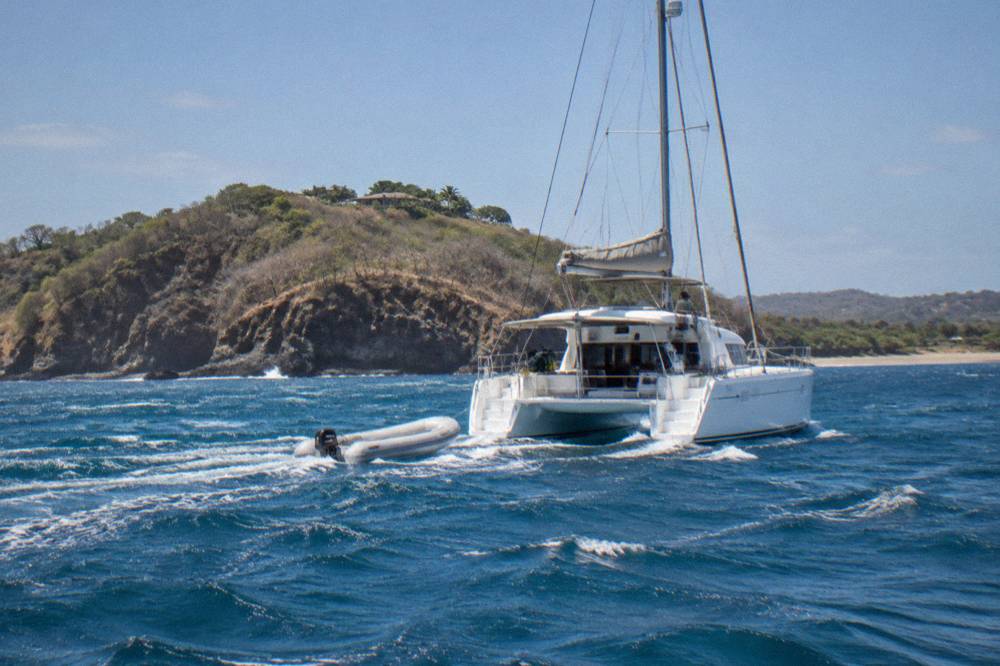
Windage is the technical word, and it is the honest answer to why you sometimes wait at the beach while the boat repositions. Tamarindo departures from the El Chiringuito area often involve anchoring offshore and ferrying guests to the sand by dinghy or even a wet landing through the surf line, and a catamaran blown sideways by an afternoon gust makes that ferry operation slower and more deliberate. The listings that depart from Marina Flamingo or the Lazy Lizard sailing base at Playa Flamingo use a calmer marina-side beach boarding, which is one reason some Tamarindo visitors accept the transfer north up the coast, and several Flamingo departures list hotel pickup in Tamarindo explicitly. A wet landing is a small annoyance next to the bigger question of whether the town itself suits you. Our honest guide to whether Tamarindo is worth visiting covers the crowds, prices, and seasons that shape that decision.
Under sail, the same lightness cuts both ways. A catamaran does not heel, which is why non-sailors love it, but it also gives up the natural feedback of a monohull leaning over. Skippers reef early and sail conservatively with passengers aboard, so on a typical Tamarindo cruise the sails go up for a relaxed reach along the coast and come down well before anything feels sporty.
Safety on any of these boats is regulated rather than informal. Coast-guard guidance reported in the Costa Rican press requires life jackets matching the boat's approved passenger capacity, kept visible and undamaged with children's sizes carried separately, at least one lifebuoy with rope, and a valid navigation certificate confirming an annual technical inspection. If you want a fuller treatment of how these boats behave when the Pacific gets bouncy, the companion piece on whether catamarans can handle rough seas goes deeper, and the general guidance for swimmers, that coastal waters carry currents and many beaches lack supervised lifeguard coverage under Costa Rica's lifeguard law, is worth reading before any trip.
Does A Catamaran Cost More Than A Monohull Trip?
Yes, and by a lot at the top end: catamarans cost more to build, to berth and to fuel than monohulls of comparable passenger count, and across these listings that shows up as shared sunset cruises from $88 to $133.35 per person and private charters from $500 to $2,972.98 per group. A few listings price only on the live page.
Here is the honest price picture from these trips, using the firm per-person figures only:
| Trip | Rating | From (per person) | Duration | Departure |
|---|---|---|---|---|
| Budget Pacific Lounge sunset | 4.8 from 30 reviews | $88 | 5 hours | El Chiringuito, Tamarindo beach |
| 5-Hour Guided Sunset Boat Tour | 4.6 from 180 reviews | $95 | 5 hours | El Chiringuito, Tamarindo beach |
| Flamingo sunset catamaran (most reviewed) | 4.9 from 1,170 reviews | $95 | 4 hours | Playa Flamingo |
| Timarouba sunset sail | 4.5 from 504 reviews | $97 | 5 hours | El Chiringuito, Tamarindo beach |
| Pacific Lounge public sunset | 4.3 from 69 reviews | $98 | 5 hours | Tamarindo |
| Blue Dolphin day catamaran | 4.5 from 990 reviews | $90 | 4.5 hours | El Chiringuito, Tamarindo beach |
| Marlin del Rey day sail | 4.6 from 685 reviews | $132 | 4.5 hours | Departure point not stated |
Note what the table quietly demonstrates: the per-person spread between the cheapest and priciest shared catamaran here is roughly $45, and the differences are mostly duration, boat and inclusions rather than any dramatic quality gap. The Blue Dolphin day catamaran at from $90 per person, rated 4.5 from 990 reviews, is a large well-established boat; the Marlin del Rey day sail at from $132 is also a large well-established boat. You are not paying more for a better class of vessel so much as for a different package.
The private side is where catamaran economics bite. Because the buyer pays for the whole boat, the per-group figures range from from $500 for a four-hour private snorkel boat to from $2,972.98 for a private charter on the Marlin del Rey, with the private sailing catamaran from Tamarindo at from $800 per group for 4.5 hours as the accessible middle. Split those across a full group of friends and the per-person number can drop below a shared ticket, which is the classic way around the cost disadvantage. The private charter guide breaks the per-group math down trip by trip.
Is The Wide Deck A Disadvantage In Practice?
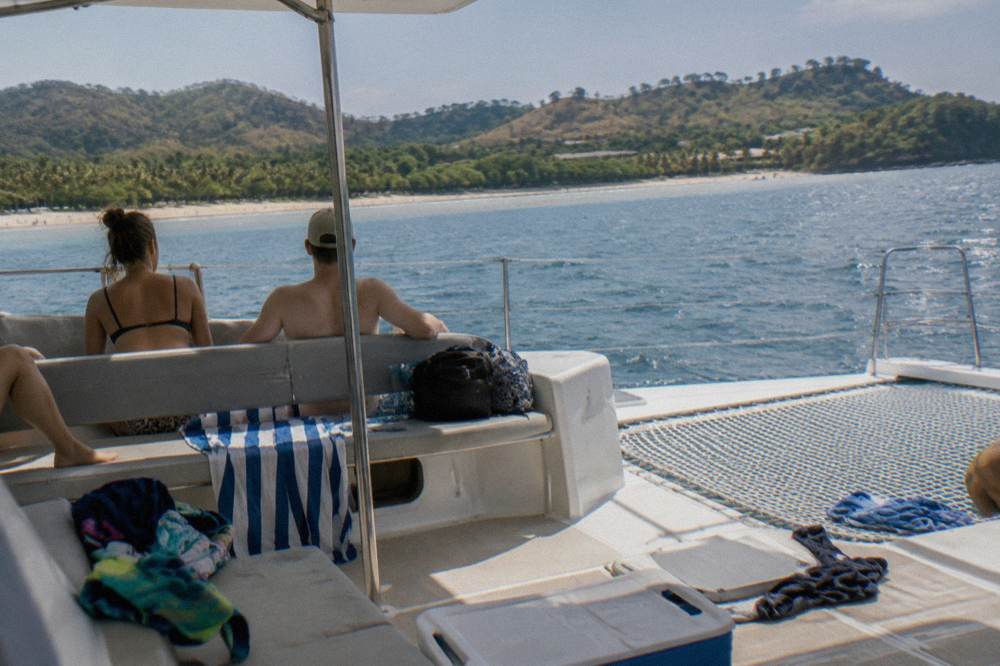
It can be: a catamaran's great virtue, its broad open deck, is also its most exposed space, with less deep sheltered cabin than a monohull, so sun, spray and the odd passing squall reach every single guest on board at once. On a hot Guanacaste afternoon the shade canopy matters more than you think, and on a green-season cruise with a rain shower passing through, everyone on the trampoline nets gets wet at the same moment.
Sun exposure deserves special mention because Tamarindo sits about ten degrees north of the equator and the sun here is serious even under cloud. Operators and marine-protected areas in Costa Rica increasingly encourage reef-safe mineral sunscreen, and the country created a reduced tariff line for reef-safe products in a 2026 customs resolution; there is no nationwide chemical ban, but bringing the mineral kind is both the courteous and the practical choice. A hat, a rash guard and more water than you think you need cover most of it.
The wide layout has a subtler social drawback too. On a monohull, people sort themselves into cockpit, cabin and foredeck, and the boat feels smaller than its length. On a tour catamaran, everyone shares one big deck with the bar and the seating, which is wonderful for a party and less wonderful if you wanted a quiet corner.
What About Windy Season And Snorkeling?
The Papagayo winds, which peak December through March, chop the surface and reduce underwater clarity, and operators report dry-season visibility of 15 to 25 meters versus 8 to 12 meters or less in the green season, so snorkeling quality from any boat, catamaran or not, varies by month. This is a coast condition, not a catamaran fault, but a wide boat anchored beam-on to the chop makes the swim ladder livelier.
The mitigation is built into the itineraries. Open-beach water at Tamarindo itself is often cloudy from sediment and surf, and clarity improves markedly at sheltered coves and around the islands north of the bay, which is why the cruises motor out before stopping to swim. The morning departures recommended in windy months catch the calm window before the wind builds after late morning. If snorkeling is the whole point of your trip, the Tamarindo snorkeling tours guide ranks the options, and the wider best time for a Tamarindo boat tour guide maps the seasons month by month.
A quick comparison of how the two hull types handle the conditions you will actually meet here:
| Condition | Catamaran behavior | Monohull behavior |
|---|---|---|
| Calm dry-season morning | Flat, spacious, stable swim platform | Gentle sway, less deck room |
| Afternoon wind chop | Quick snap roll, spray on the nets | Slower lean, hull shelters guests |
| Beam swell at anchor | Rocking at the mooring, ladder moves | Steadier at anchor, deeper motion |
| Swimming and snorkel stop | Wide stairs, big platform, easy entry | Narrow ladder over the side |
| Crowded peak-season deck | Everyone shares one open space | Guests spread across cockpit and cabin |
For families, that table usually resolves in the catamaran's favor, which is why the format dominates the family market here. The morning nature catamaran with kids' games, from $98 per person for 4.5 hours with lunch and open bar, is built exactly around the wide-deck advantage: games on the flat platform, a roof deck for the adults, and a moored swim stop in a bay. Check the listing for minimum ages, which vary by trip.
So Who Should Skip The Catamaran?
Skip a catamaran if you get seasick in quick short-period motion, if you want a sailing purist's ride with heeling and a deep cockpit, or if your budget sits below the cheapest shared ticket at from $88 per person, in which case the free and near-free options in town beat stretching for a boat trip. Everyone else, honestly, should book the catamaran.
The monohull loyalist argument deserves a fair hearing even here. A monohull under sail feels alive in a way a catamaran deliberately does not; it heels, it hums, it gives the crew something to do. If you grew up sailing dinghies and want your children to feel the rail go in the water, a big tour catamaran with its bar and burrito buffet will feel like a floating patio. That is a preference, not a defect, and it is the one criticism no spec sheet can answer.
For the seasick-prone, the calculus is about exposure time and timing rather than hull type. A four-to-five-hour protected-coast cruise in the morning calm window is a mild experience by any standard, and medication, midship seating and horizon-watching handle most of the rest. The deeper treatment is in the piece on whether catamarans can handle rough seas, which also covers what the coast-guard life-jacket rules mean for you as a passenger.
One group genuinely underserved by catamarans does exist: travelers who wanted a small, quiet, intimate boat. A tour catamaran carrying dozens of guests is the opposite of intimate. The closest fits here are the intimate sailboat experience with local cuisine, from $900 per group for up to 6 guests, and the private snorkel boat at from $500 per group, both smaller vessels than the sunset fleet, and neither a catamaran in the big-deck sense. For a full honest comparison of every hull and format running from this coast, the Tamarindo boat tours compared guide is the reference page.
| Traveler | Honest verdict | Best-fit trip |
|---|---|---|
| Seasickness-prone | Morning departure, medication, midship seat | Blue Dolphin day catamaran, from $90 |
| Family with kids | Catamaran wins outright | Morning family nature catamaran, from $98 |
| Sailing purist | Compromise: sunset sail, sails do go up | Timarouba sunset sail, from $97 |
| Group of 8-plus | Private beats shared on per-person cost | Private sailing catamaran, from $800 per group |
| Budget solo traveler | Shared public sunset is the floor | Budget Pacific Lounge sunset, from $88 |
The Bottom Line Before You Book
The honest verdict is that the disadvantages of a catamaran are real but contextual: quicker motion in beam chop, more windage at the dock, a higher price than a comparable monohull operation, and one big shared deck instead of cozy separate spaces, yet on a four-to-five-hour protected coastal cruise out of Tamarindo every one of them is managed by the format itself. Morning departures dodge the wind, moored swim stops keep the swell away, skippers reef early, and a crew that docks these boats daily makes the maneuvering look routine. This is why every operator on this coast runs them. The team behind Tamarindo Catamaran Cruises compares the full catalogue, the good and the bad, so the choice you make is informed rather than default.
If you want to test the format with the least risk, the featured Timarouba sunset sail is the sensible first booking: five hours, from $97 per person, rated 4.5 from 504 reviews, with lunch, open bar, snorkel gear, two kayaks and a paddleboard, free cancellation listed, departing the El Chiringuito area of Tamarindo beach. One afternoon answers the hull question better than any article can.
Common Questions About Catamaran Disadvantages
What is the disadvantage of a catamaran?
The main disadvantages are quicker shallow rolling in beam seas or wind chop, high windage that makes docking and slow-speed maneuvering harder and sometimes slower, higher build and berth costs that push ticket prices up, and one wide open deck that exposes everyone to sun and spray rather than sheltering them in a hull. For short coastal cruises like Tamarindo's, operators manage most of these through timing and itinerary.
Do catamarans rock more than monohulls?
In beam seas, yes. A catamaran bridges wave crests and snaps level-to-level in a short-period roll, which some passengers find more queasy than a monohull's slow lean. In calm water and on moorings protected from swell, catamarans are the steadier platform, which is why they dominate day cruises.
Is a catamaran bad if you get seasick?
Not automatically. Motion sensitivity varies by person and by conditions. Booking a morning departure, sitting amidships, watching the horizon and taking medication before boarding handle most cases on a four-to-five-hour coastal cruise. In Tamarindo's windy Papagayo months, December through March, the morning timing matters most.
Why are catamaran tours more expensive?
Catamarans cost more to build, dock and fuel than monohulls of similar capacity. Across these trips, shared cruises run from $88 to $133.35 per person and private charters from $500 to $2,972.98 per group, with a few listings priced only on the live page. Splitting a private charter across a full group often beats shared per-person pricing.
Are catamarans safe for families with kids?
The format is well suited to families: flat decks, wide swim stairs and no heeling. Costa Rican coast-guard guidance requires life jackets matched to passenger capacity including children's sizes, a lifebuoy with rope, and a valid navigation certificate. Check each listing for minimum ages, which vary by trip.
Should I book a monohull instead in Tamarindo?
Choose a smaller or more intimate boat only if the big shared deck is the specific drawback you want to avoid, such as the intimate sailboat experience for up to 6 guests. The day-cruise fleet on this coast is overwhelmingly catamaran, and for sunset sails, snorkel stops and family trips the disadvantages rarely outweigh the stability and space.