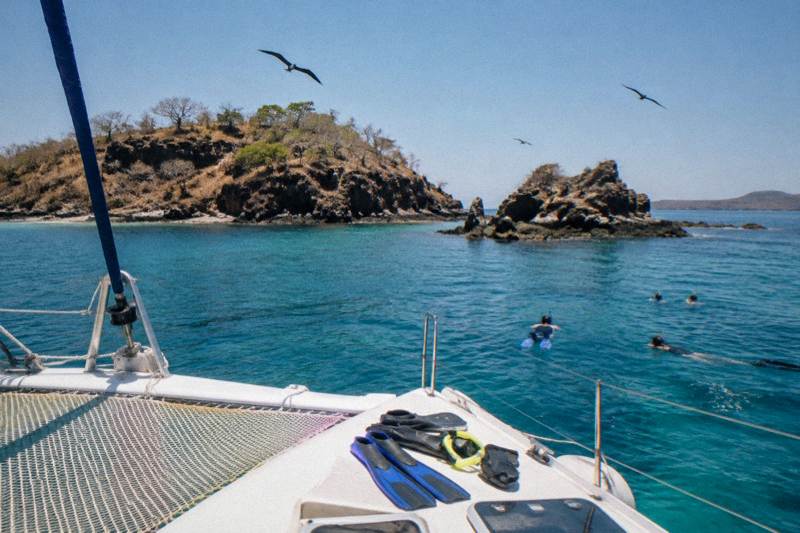
Tamarindo Snorkeling Tours: Where Boats Go And What You See
Tamarindo's open beach is surf water, not reef water, so the snorkeling here happens by boat: catamaran sails that stop at coves, Playa Conchal and the Catalina Islands along the Guanacaste coast.
Short answer
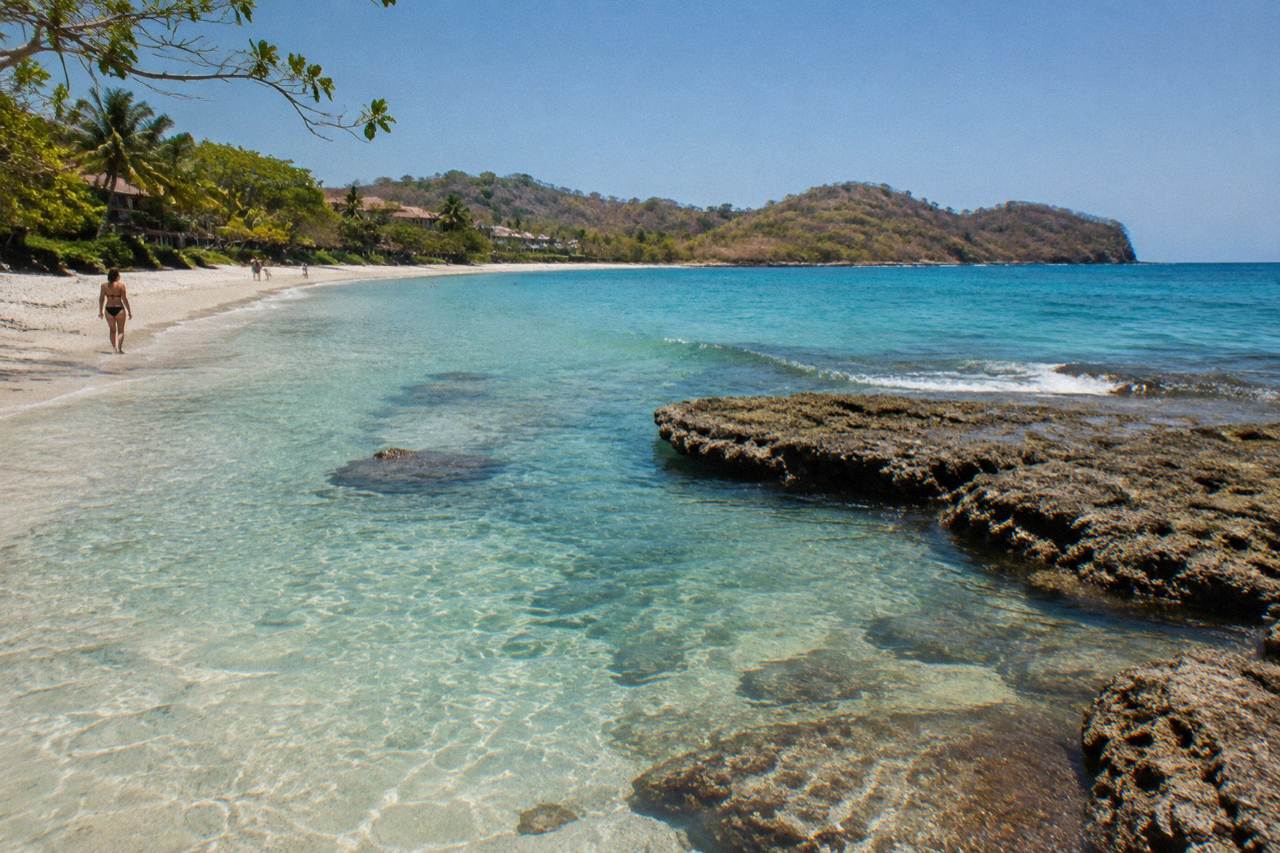
Snorkeling from Tamarindo is boat-based. Shared catamaran day sails run from about $90 to $169 per person, last 4 to 5 hours, and include snorkel gear, a meal and an open bar on most listings. Boats stop at sheltered coves, Playa Conchal or the Catalina Islands, where water clarity beats the open beach.
Playa Tamarindo itself is a broad, wave-worked surf beach, and the water over its own sand is often stirred up and cloudy. The snorkeling that Guanacaste is known for sits offshore and up the coast: at rocky coves, at shell-strewn Playa Conchal, and around the Catalina Islands, where operators report rays, dolphins and reef fish. Most snorkeling trips on this site run on catamarans, with a sailboat, a snorkel boat and a yacht rounding them out, which matches how the coast actually works. You reach the good water by sail.
This guide lays out where Tamarindo snorkel boats actually go, what the listings include, how visibility shifts between the dry and green seasons, and what marine life is reported in the water. Prices and ratings below come from the live listings themselves.
Where Can You Snorkel From Tamarindo?
The snorkel stops on Tamarindo-area trips are sheltered coves along the coast, Playa Conchal, and the Catalina Islands, roughly a 45-minute sail from Tamarindo; the open beach at Tamarindo itself is often too cloudy for good snorkeling because of sediment and wave action. That clarity gap is the single most useful fact for planning. Press reporting on Tamarindo snorkeling notes that visibility at the main beach is frequently reduced by sediment and surf, while nearby coves and the Catalina Islands offer markedly clearer water. The boats exist precisely to bridge that gap.
A typical day sail leaves Tamarindo in the morning, sails the coast for about an hour, then moors at a bay for swimming, snorkeling, kayaks and paddleboards before lunch and the sail home. Operators describe secluded bays away from crowds as the normal mid-trip stop. The listing for the Blue Dolphin day catamaran, one of the most established products on this coast with 990 reviews at 4.5, boards at the El Chiringuito area of Tamarindo beach and runs 4.5 hours from $90 per person with snorkel gear, a stand-up paddleboard, a chicken fajita meal and an open bar.
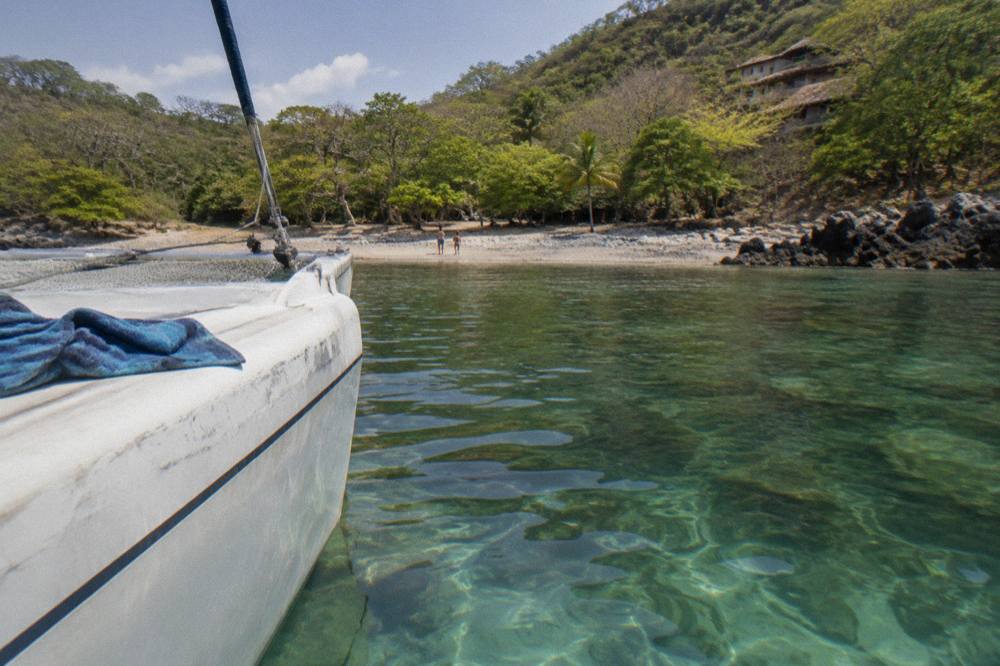
The named destinations deserve separate mention. Playa Conchal is rated highly for shells and snorkeling, and some Tamarindo snorkel and wildlife boat tours list it as a stop alongside the Catalinas Islands, which are known for manta rays and dolphins. The Catalinas sit close enough that a listing describes the sail from Tamarindo to Islas Santa Catalina at about 45 minutes, with guided snorkeling sessions and marine life spotting. Las Baulas National Marine Park, next door to Tamarindo, allows shallow diving at Playa Carbon and surfing at Playa Grande and Langosta, per the official SINAC park page; the park's nesting beaches are for turtles, not snorkel boats, and vessels do not land there.
| Snorkel stop | How trips describe it | Distance or access |
|---|---|---|
| Sheltered coast coves | Usual mooring spot on day sails; kayaks and paddleboards launched here | About 1 hour of sailing north from Tamarindo, per a listing |
| Playa Conchal | Rated highly for shells and snorkeling; stop on some wildlife boat tours | About 29 to 35 minutes by road from Tamarindo, by boat as part of a tour |
| Catalina Islands | Manta rays and dolphins reported; guided snorkel sessions | About a 45-minute sail from Tamarindo per a listing |
| Playa Carbon (Las Baulas park) | Shallow diving listed among park water activities | Inside the national park; reached from shore, not by tour catamaran |
| Playa Tamarindo beach | Often cloudy from sediment and waves; surf beach | Walk-on, but rarely the clear-water snorkel people picture |
For trip-by-trip detail beyond snorkeling, the companion page on Tamarindo sailing tours covers the same boats from a sailing-first angle, and Playa Conchal by boat digs into that stop in depth.
Which Tamarindo Snorkeling Tours Include Gear, A Meal And A Guide?
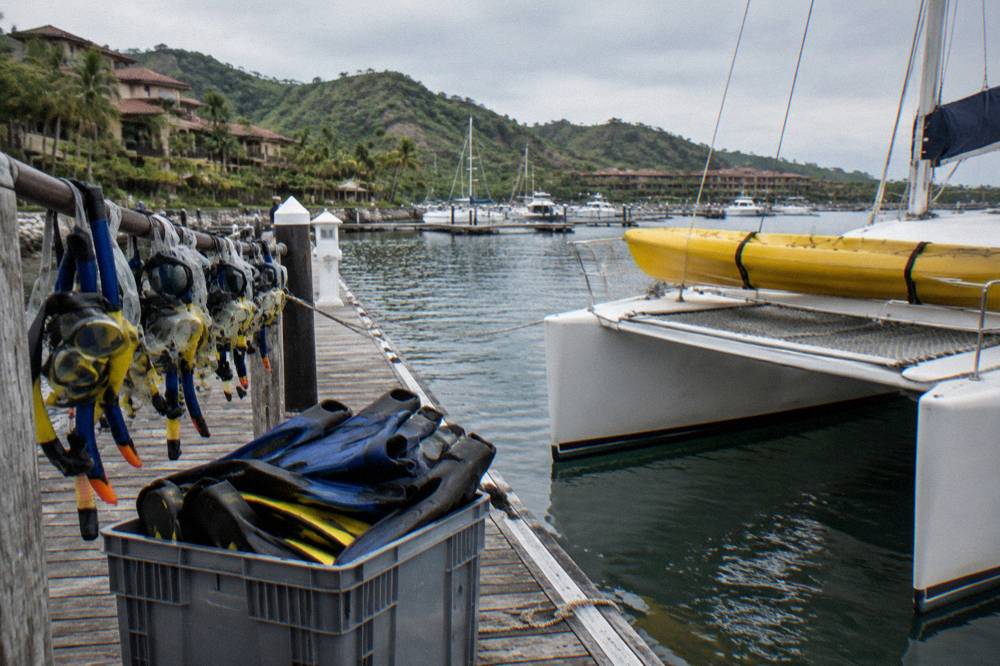
All but one of the snorkel-day-cruise listings here include snorkel equipment, most pair it with a meal and an open bar, and shared trip prices run from $90 to $169 per person, lasting 4 to 5 hours. Gear, food and drinks are effectively bundled on this coast; the differences that matter are duration, departure point and whether kayaks and paddleboards ride along. Guides are part of several listings too: the Playa Flamingo catamaran with meal lists a guided tour for snorkeling, and the Flamingo day trip lists a certified guide.
The table below compares the shared day sails that carry the strongest review pools. Ratings are printed with their review counts because a number without its pool means little.
| Listing (card name) | Price | Rating | Duration | Departure | Extras in the listing |
|---|---|---|---|---|---|
| Blue Dolphin Day Catamaran | from $90 per person | 4.5 from 990 reviews | 4.5 hours | El Chiringuito area, Tamarindo beach | Meal, open bar, SUP |
| Marlin del Rey Day Sail, Lunch | from $132 per person | 4.6 from 685 reviews | 4.5 hours | Departure point not stated | Lunch, open bar, snacks |
| Timarouba Day Sail, Lunch and Drinks | from $99.50 per person | 4.5 from 203 reviews | 4 hours | El Chiringuito area, Tamarindo beach | Kayaks, paddleboards, unlimited bar |
| All-Inclusive Day Sail, 4.5 Hours | from $90 per person | 4.5 from 123 reviews | 4.5 hours | Calle Cruz, Tamarindo | Lunch, drinks, 2 kayaks |
| Flamingo Catamaran, Lunch and Drinks | from $100 per person | 4.9 from 20 reviews | 4 hours | Marina Flamingo, Playa Flamingo | Buffet lunch, certified guide, cocktails |
| Morning Catamaran With Kids' Games | from $98 per person | too few reviews for a rating | 4.5 hours | El Chiringuito area, Tamarindo beach | Lunch, open bar, kids' games |
The trio below is the shortlist this site would put in front of most snorkel-first readers: the Marlin del Rey day trip as the widely reviewed classic, the Timarouba day sail as the same-family alternative with kayaks and paddleboards, and the all-inclusive 4.5-hour sail as the format-and-price contrast.
A note on gear quality and fit: listings promise equipment, not specific brands. The Costa Rica Coast Guard, through guidance reported in the Costa Rican press, requires boats to carry life jackets matched to passenger capacity, visible and undamaged, with children's sizes on hand, plus a lifebuoy and a valid navigation certificate. It is reasonable to ask the crew at boarding where the child-sized vests are; on open-hull boats the same guidance says everyone wears one.
Families have a dedicated option in the morning nature catamaran with kids' games, a 4.5-hour Tamarindo departure from $98 per person that lists lunch, an open bar and snorkel stops alongside onboard games. Its review pool is too small for a star claim, so judge it on the itinerary, not a rating. And if your real question is which boat overall, the comparison page on Tamarindo boat tours compared lines up the whole catalogue.
Do You Need To Take A Boat To Snorkel In Tamarindo?
Yes, in practice: the clear-water snorkeling around Tamarindo is reached by boat, since the main beach's water is often cloudy from sediment and waves, while coves and the Catalina Islands hold the visibility, and the trips that get you there are the catamaran day sails and snorkel sails in this catalogue. Shore snorkeling at Tamarindo is not impossible on a calm dawn, but it is not what the coast is known for, and none of these trips is a walk-in reef trip. There is no estuary, jungle or land tour among these trips. Nearly all are catamarans.
That is less a limitation than it sounds. A boat reframes the day: an hour of coastal sailing, a moored swim stop with noodles and floats in the water, lunch on deck, and a downwind run home. The all-inclusive catamaran sailing tour from Calle Cruz, from $90 per person and rated 4.5 from 123 reviews, lists its day as exactly that shape, with two kayaks and snorkel equipment in the inclusions. The Timarouba day sail, from $99.50 per person at 4.5 from 203 reviews, boards at the El Chiringuito area and adds kayaks and paddleboards to the snorkel gear and unlimited bar.
One honest caveat on turtles, because snorkelers ask constantly: sea turtles are seen on these trips, recent guest reviews of the Marlin del Rey catamaran report turtles, dolphins and whales, but no operator can promise a sighting, and the leatherback nesting beaches inside Las Baulas are closed to this kind of tourism. The 2026 nesting season is reported very low and organized turtle observation inside the park is reportedly unavailable; boats do not enter the nesting beach. The Las Baulas park and Tamarindo boats page explains the park rules in full.
How Does Snorkel Visibility Change With The Season?
Operators report dry-season visibility of 15 to 25 meters from December to April, against 8 to 12 meters or less in the green season from May to November, and October is the wettest month in the 30-year rainfall normals, so the clearest water pairs with the driest months. The trade-off is crowds and wind: the Papagayo winds peak December to March and can roughen the surface even while the water underneath is clear, which is why several operators recommend morning departures, since wind tends to rise after about 11 am.
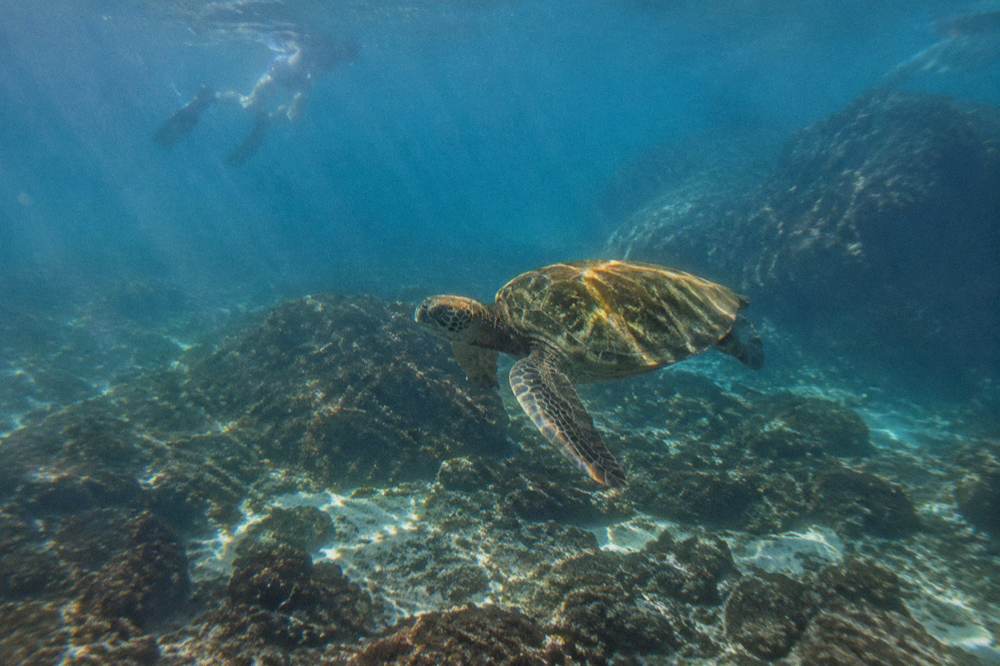
The seasonal mechanics are simple. Guanacaste's dry season strips rain from the coast, so rivers and runoff stop feeding sediment into the nearshore water, and the sea settles. The green season brings afternoon rains, stronger swells and murkier surface water, though the mornings are frequently fine and the coast is dramatically greener. Sea temperature barely moves: the monthly average along the Guanacaste coast runs from about 27.3 C in January to about 29.4 C in May, warmest in May and coolest in January and February. Rain, sea temperature and whale timing all feed the wider question of the best time for a Tamarindo boat tour, and the green-season specifics sit in Tamarindo boat tours in rainy season.
| Period | Rain pattern (30-year normals) | Visibility as operators report | What it means for a snorkel trip |
|---|---|---|---|
| December to April (dry) | February the driest month; December light at 14 mm | 15 to 25 m | Clearest water; Papagayo wind chop December to March, favor morning trips |
| May to August (early green) | May 241.6 mm, June 286.1 mm, August 249.5 mm | 8 to 12 m or less | Lush coast, lighter crowds; expect afternoon rain |
| September to November (late green) | October the wettest month, with September close behind | 8 to 12 m or less, reduced further after storms | Lowest visibility; check the weather and the operator's cancellation terms |

None of this makes a green-season trip a bad buy. Reviews of Tamarindo catamarans through the middle of the year are largely positive, crews adjust the swim stop to the day's conditions, and the visibility figures are operator-reported ranges, not guarantees for any given morning. Book the day, check the sky, and go with the morning departure if wind is in the forecast.
What Marine Life Do Snorkelers Report On The Guanacaste Coast?
Snorkel listings for the Tamarindo and Catalina Islands area commonly name dolphins, sea turtles, puffer fish, schools of snapper and reef fish, and occasional manta rays or reef sharks, and 2026 guest reviews of the Marlin del Rey catamaran report turtles, dolphins, whales and flying fish, though no sighting is ever guaranteed. Around the Catalinas specifically, manta rays and dolphins are the headline species in tour descriptions. Closer in, cove snorkeling is mostly reef fish, and that is the more realistic expectation for a moored swim stop.
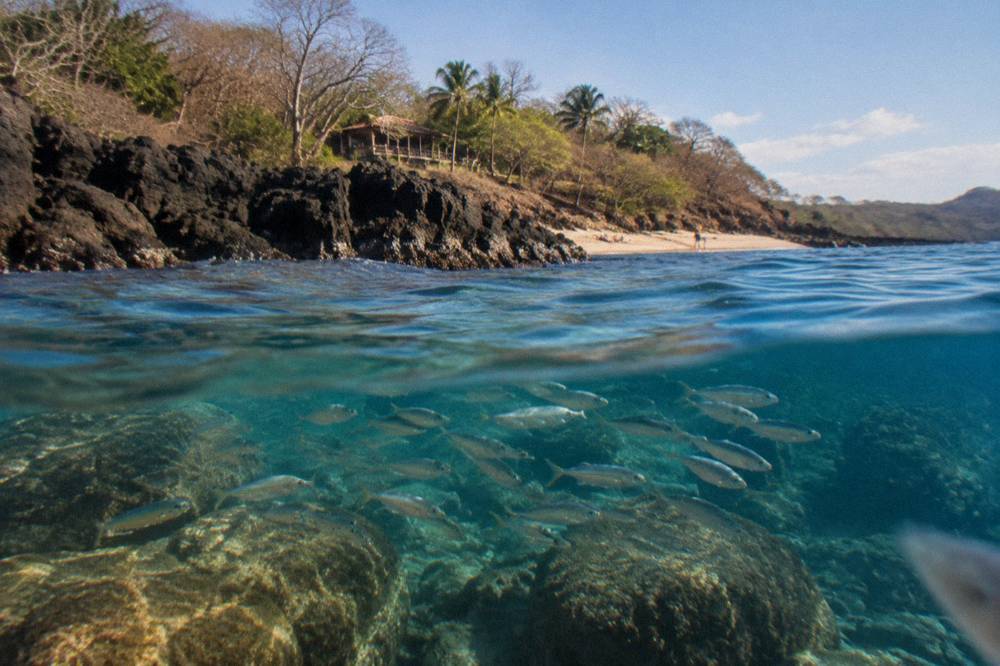
Whales deserve their own paragraph because the timing is genuinely good. Humpbacks pass this coast twice a year: a northern group reported December to March or April, and a southern group roughly July to mid November, peaking August to September, according to press reporting and the ICT's northern Guanacaste guide. That means most of the calendar has some whale potential in Guanacaste waters, and sightings from Tamarindo catamarans appear in 2026 guest reviews. Always treat it as a possibility, not a promise; no listing here sells a guaranteed whale.
Two practical notes from the rules side. Costa Rica has no verified whale-watching distance rule specific to Guanacaste, so do not be alarmed if a boat's approach differs from what you have read about other countries; those rules are often Mexican. And on sunscreen, there is no nationwide chemical-sunscreen ban, but a 2026 customs resolution created a reduced tariff line for reef-safe mineral products, and marine protected areas and operators increasingly encourage them. Packing guidance, including reef-safe sunscreen and towels, is gathered in what to bring on a Tamarindo catamaran.
Tamarindo Beach Or Playa Flamingo: Which Departure Suits You?
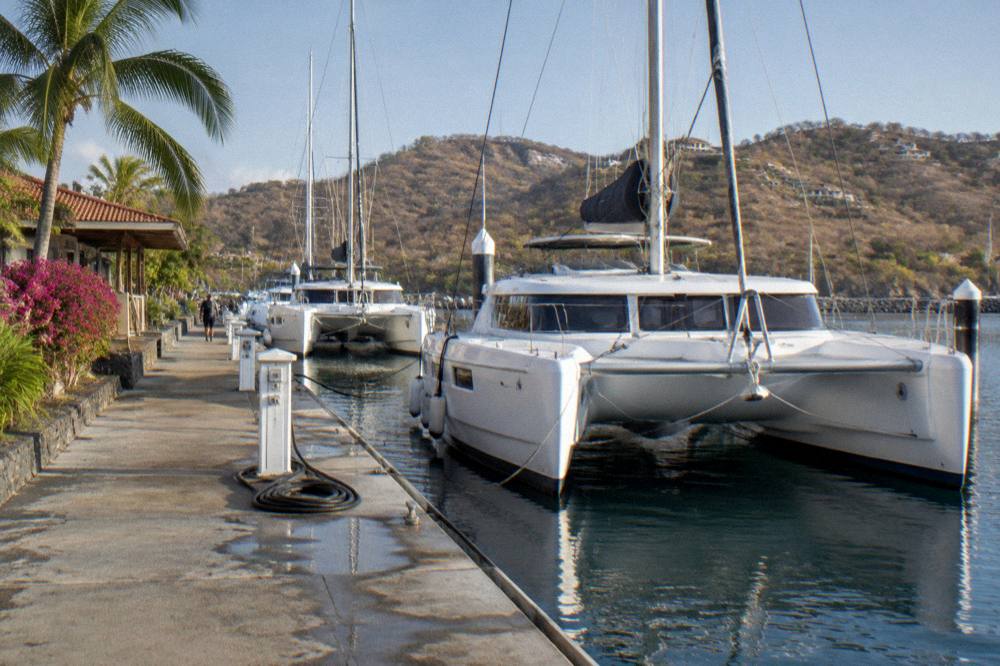
Tamarindo departures board at the El Chiringuito area of Tamarindo beach or nearby central points, while Flamingo departures leave from Marina Flamingo or the Lazy Lizard area about 31 to 35 minutes up the coast, and the Flamingo listings are the ones that list Tamarindo hotel pickup, so your base decides the answer. This matters more than most first-time visitors expect. A Flamingo departure with listed pickup from Tamarindo, Potrero, Las Catalinas or Playa Flamingo hotels removes the beach-boarding logistics entirely, which families often prefer.
| Departure | Boarding point | Listings that use it | Pickup stated? |
|---|---|---|---|
| Tamarindo beach | El Chiringuito area, Calle Cruz, Caballo del Mar | Blue Dolphin day and sunset trips, Timarouba sails, Pacific Lounge, all-inclusive day sail | Not stated on those lines; check the listing for transport |
| Playa Flamingo | Marina Flamingo, Lazy Lizard Sailing area | Flamingo sunset catamaran, Flamingo catamaran with meal, morning and private Flamingo trips | Pickup listed on several Flamingo lines, including Tamarindo hotels |
| Playas del Coco | Departure point not stated | Marlin del Rey shared trips | Not stated; check the listing |
The Flamingo catamaran tour with meal, rated 4.7 from 178 reviews and from $95 per person for 4 hours, lists local hotel pickup and drop-off covering Potrero, Las Catalinas, Playa Flamingo and Tamarindo, plus kayaks, SUPs, snorkel equipment, noodles and life jackets, and a guided tour for snorkeling. For a reader staying in Tamarindo without a car, that is a strong combination of clarity about transport and water toys. Its sibling Flamingo day trip from Marina Flamingo, from $100 per person and 4.9 from 20 reviews, includes a buffet lunch and a certified guide but states no pickup, a good reminder to read each listing's own line rather than assuming the family resemblance goes all the way down.
Whichever departure you choose, the departure is a beach, not a marina, on the Tamarindo side. Boarding at El Chiringuito typically means walking to the water's edge and boarding from the sand or a dinghy, so wear something that can get wet to the knee and leave the big camera bag in the hotel. The Playa Flamingo boat tours page covers that side of the coast in more detail.
What Should You Expect To Pay For A Tamarindo Snorkel Sail?
Shared snorkel-day catamarans among these listings run from $90 to $169 per person firm-priced, with the two $90 listings being the Blue Dolphin day catamaran and the all-inclusive Calle Cruz sail, and private snorkel options starting at $500 per group for a 4-hour boat charter, all with free cancellation listed. Those per-person prices almost always bundle the snorkel gear, a meal and drinks, so the sticker compares well against paying separately for gear rental, lunch and a water taxi.
| Spend level | What the listings show | Product example |
|---|---|---|
| Under $100 per person | 4 to 4.5-hour shared day sails with gear, meal and bar | Blue Dolphin day catamaran, from $90; all-inclusive day sail, from $90 |
| $100 to $132 per person | Longer or larger-boat shared sails, Flamingo departures | Flamingo catamaran with meal, from $95; Marlin del Rey day sail, from $132 |
| Private, from $500 per group | Dedicated boats for your party only | Private snorkel boat tour with photos included, from $500 per group, 4 hours |
| Private catamarans, $800 to $2,972.98 per group | Full catamaran charters with crew | From $800 per group for a 4.5-hour private catamaran up to $2,972.98 per group on the Marlin del Rey charter |
The budget versus value question has a clean answer on this coast. The cheapest firm-priced day sail is not a stripped product: at $90 you still get snorkel gear, lunch and drinks on both listings at that price. What more money buys is duration, boat size, toys like kayaks and paddleboards, or privacy. The full price breakdown, including sunset trips and charters, lives in Tamarindo catamaran cruise prices.
Tipping sits outside the listed price. Operators and travel sites report that boat tour crews in Guanacaste commonly receive about 5 to 10 USD per person for a half-day tour and 10 to 20 USD for a full day; it is a reported custom, not a rule, and the tipping on Costa Rica boat tours page treats it in full.
Booking is simple on every one of these trips: free cancellation is listed on all of them, so reserving a morning sail before you travel costs nothing to move if the forecast turns. Read the listing you actually book, not the family sibling, since durations, departures and inclusions differ between same-operator products, and Tamarindo Catamaran Cruises keeps each listing's details separate for exactly that reason. Before you commit, a quick look at the live listing confirms the day's departure time, the meeting point and what the crew asks you to bring.
Common Questions About Tamarindo Snorkeling Tours
Can you snorkel straight from Tamarindo beach?
You can swim from the beach, but the water is often cloudy from sediment and waves, and the good visibility is at coves and the Catalina Islands reached by boat. Tamarindo's snorkeling is effectively boat-based, and nearly all these listings are catamaran trips.
The dry season, December to April, when operators report 15 to 25 m visibility against 8 to 12 m or less in the green season. February is the driest month in the 30-year normals. Within any day, a morning departure beats the afternoon because wind tends to rise after about 11 am. Yes, mostly: all but one of these snorkel-day-cruise listings include snorkel equipment, and most pair it with a meal and an open bar. Kayaks and paddleboards are listed on several trips, including the Timarouba day sail and the Playa Flamingo catamaran with meal. No sighting is guaranteed. 2026 guest reviews of the Marlin del Rey catamaran report turtles, dolphins and whales, and humpbacks are reported off Guanacaste from December to March or April and July to mid November, peaking August to September. The leatherback nesting beaches inside Las Baulas are off-limits; boats do not enter them. Shared day sails run from $90 to $169 per person across these listings, lasting 4 to 5 hours with gear, meal and drinks bundled. Private options start at $500 per group for a 4-hour snorkel boat and climb to $2,972.98 per group for a large private catamaran. Only some listings state hotel pickup, mainly the Playa Flamingo departures, one of which lists pickup covering Tamarindo, Potrero, Las Catalinas and Playa Flamingo. Most Tamarindo-departing lines state no pickup, so check the listing for transport before you book.What is the best time of year for snorkeling in Tamarindo?
Do Tamarindo snorkeling tours include gear and food?
Will I see turtles or whales on a Tamarindo snorkel tour?
How much does a Tamarindo snorkel tour cost?
Do the tours pick up from Tamarindo hotels?