Tamarindo Weather By Month: Sea, Rain And Wind For Boat Days
Tamarindo sits on the dry corner of Costa Rica's Pacific coast, and the calendar decides whether your boat day is flat and glassy or green and dramatic. Here is what each month actually delivers.
Short answer
Tamarindo has a dry season from December to April and a green season from May to November. February is the driest month on 30-year normals with 3.5 mm of rain, October the wettest with 354.1 mm. Sea temperature stays warm year round, from about 27.3 C in January to 29.4 C in May, and sunset runs between about 5:16 pm and 6:08 pm.
Tamarindo gets about 1,825 mm of rain in an average year, and almost none of it falls between December and April. That single fact shapes every boat day on this stretch of the Guanacaste coast: the winter months bring flat morning seas, crowds and dust, while the green months bring afternoon downpours, lush hills and emptier decks. The catamaran calendar here does not stop in the wet season, it just changes character. Along the way this guide covers the wind, the swell, the sunset times and the whale windows, because those, not the rain gauge, are what actually decide whether a sunset sail or a snorkel cruise feels like the brochure.
What Is The Weather Like In Tamarindo Month By Month?
Tamarindo runs a textbook tropical dry-and-green cycle: bone dry from December through April, wet from May through November, with February the driest month on record at 3.5 mm of rain and October the wettest at 354.1 mm. Air temperatures stay warm all year, and the sea never drops below about 27 C. For a boat day, the month you pick matters more than the week.
The 30-year rainfall normals for Tamarindo, covering 1990 to 2020, tell the story bluntly. January through March each average under 5 mm for the entire month. April ticks up to 36.2 mm, then the tap opens: May averages 241.6 mm, June 286.1 mm, and the second half of the year stays wet through a 354.1 mm October peak before November falls back to 117.7 mm and December dries out to 14 mm. Nothing here is Arctic cold or furnace hot; the swing is between dry-brown hills and dripping-green ones.
Here is the full month-by-month picture, with the boat-day angle built in:
| Month | Avg rain (mm) | Sea temp (avg) | Boat day character |
|---|---|---|---|
| January | 4.2 | 27.3 C | Dry, breezy, peak Papagayo wind months begin |
| February | 3.5 | 27.9 C | Driest month of the year, calm mornings |
| March | 4.9 | 28.9 C | Dry, hot, wind easing late month |
| April | 36.2 | 29.3 C | Transition, first showers possible, sea warming |
| May | 241.6 | 29.4 C | Green season starts, warmest sea of the year |
| June | 286.1 | 28.8 C | Afternoon rain, green hills, quiet boats |
| July | 181.9 | 28.9 C | A drier pocket inside the wet season |
| August | 249.5 | 29.0 C | Green season, southern humpback peak builds |
| September | 330.8 | 28.7 C | Very wet, lowest crowds of the year |
| October | 354.1 | 27.8 C | Wettest month, many operators still run |
| November | 117.7 | 27.6 C | Rains tail off, coast greens then dries |
| December | 14.0 | 28.0 C | Dry season returns, high season begins |
Two readings matter for planning. First, the green season rain is not an all-day drizzle: it concentrates in afternoons, which is exactly when a morning catamaran is already back at the dock. Second, the sea temperature column barely moves, about 27.3 C in January against 29.4 C in May. You will never need a wetsuit for swimming off the boat in any month.
If you are already leaning toward a specific trip, the sunsets and sailing options from Tamarindo guide breaks down the evening trips, and the overall catamaran tours comparison covers every vessel on this coast.
When Is Dry Season And When Is Green Season In Tamarindo?
Dry season in Tamarindo runs December to April and green season May to November, following the whole Pacific coast of Guanacaste. Dry months average under 40 mm of rain each, green months between about 117.7 and 354.1 mm. Operators run catamarans in both; the difference is wind, crowds and the color of the hills.
The dry season is why this coast is called the Gold Coast. By February the landscape is tawny, the sky is cloudless for weeks at a time, and the sea along Tamarindo, Playa Flamingo and Playa Conchal settles into long, glassy mornings. This is high season: flights into Liberia fill up, and the 5-hour sunset cruises sail near capacity. The trade-off is the Papagayo wind, which peaks December through March and can roughen the surface by early afternoon, a pattern we cover in its own section below.
Green season inverts the deal. Rain typically arrives as afternoon or overnight showers rather than day-long soakers, mornings stay sailable most weeks, and the sailing itself is arguably better: cooler air, dramatic cloud over the ocean, and decks with room to spread out. The verified normals show July as a genuine drier pocket inside the wet season, at 181.9 mm against 286.1 mm in June, which is why many returning travelers book July on purpose.
For matching a trip to the season, the featured Timarouba Sunset Sail, Open Bar runs from $97 per person for 5 hours with lunch, open bar, snorkel gear, kayaks and a paddleboard listed, and free cancellation is listed, which matters when you are gambling on a green-season week.
One honest note on shoulder months: November and December are transitions, not switches. A mid-November week can deliver pure dry-season conditions, and a mid-December front can still drop an evening storm. The rainfall averages smooth that out; your specific week will not.
How Warm Is The Sea Off The Tamarindo Coast?
Sea surface temperature along the Guanacaste coast averages between 27.3 C in January and 29.4 C in May, a band so narrow that swimming off the boat is comfortable in every month of the year. The coolest readings land in January and February, the warmest in May, with a secondary warm bump through August.
Monthly averages from the Guanacaste coast, cross-checked against Tamarindo Beach data, look like this:
| Month | Avg sea temp | Month | Avg sea temp |
|---|---|---|---|
| January | 27.3 C | July | 28.9 C |
| February | 27.9 C | August | 29.0 C |
| March | 28.9 C | September | 28.7 C |
| April | 29.3 C | October | 27.8 C |
| May | 29.4 C | November | 27.6 C |
| June | 28.8 C | December | 28.0 C |
The interesting detail is that the coolest water coincides with the driest, most popular months. January and February, the heart of high season, are also the months when the sea reads a degree or two below the annual average, partly because the Papagayo winds push surface water around and draw up cooler layers. Travelers who visit in May through August swim in the warmest water of the year while paying green-season prices.
For snorkelers this cuts both ways, and we cover visibility in its own section, because temperature and clarity are not the same thing. What the temperature table settles is wardrobe: a swimsuit and a rash guard is enough in every month, and nobody needs a wetsuit for the swim stops on a Tamarindo or Flamingo catamaran. The full snorkeling trips from Tamarindo guide covers where the boats actually stop.
What Does The Papagayo Wind Do To A Catamaran Day?
The Papagayo winds, strong northeasterly gap winds, blow hardest from December through March and can churn the sea surface into short, steep chop by early afternoon. Operators report wind commonly rises after about 11 am in those months, which is why morning departures are widely recommended for the smoothest sailing and snorkeling.
The Papagayos are a real phenomenon, not a marketing line. Cool air from the Caribbean side funnels across the lowlands of Central America and spills down onto the Pacific, and Guanacaste sits directly under the chute. In a strong event the wind cools the air, whitens the water near shore and makes an afternoon sail feel more like work than a lounge cruise. Catamarans handle it well by design, a point our piece on whether catamarans can handle rough seas covers in detail, but comfort and calm are different questions.
The practical playbook in the windy months is timing. Morning trips, like the day sail format that runs 4 hours 30 minutes, catch the window before the chop builds. Afternoon and sunset trips still run daily, and many sailors actually prefer a breeze: a catamaran under sail with 15 knots is livelier than one motoring on glass. If you are wind-sensitive or prone to seasickness, book the morning slot in January through March and save the sunset cruise for a calmer week.
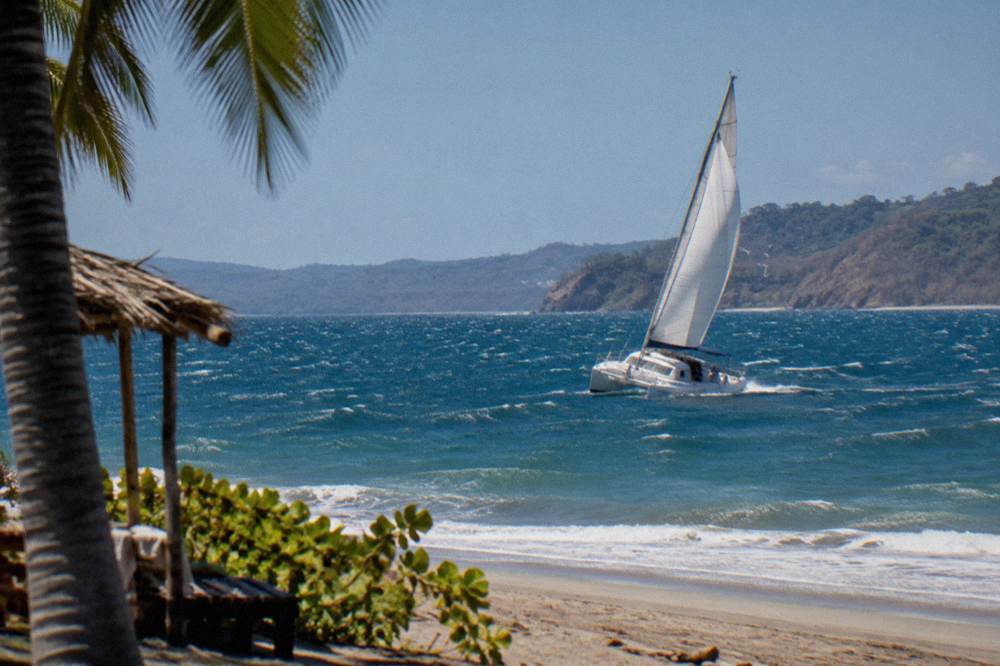
A good fit for the morning strategy is the Blue Dolphin Day Catamaran, from $90 per person for 4 hours 30 minutes, rated 4.5 from 990 reviews, with meal, open bar, snorkel gear and a stand up paddle board listed.

Which Month Has The Best Visibility For Snorkeling From Tamarindo?
Operators on this coast report snorkel visibility of about 15 to 25 m in the dry season versus about 8 to 12 m or less in the green season, when runoff and swell cloud the water. That makes December through April the strongest window for clear water, with a caveat: the open beach at Tamarindo itself is often cloudy at any time of year.
The clarity numbers come from operators who run these trips weekly, and they track the rainfall curve almost exactly. Dry months mean no rivers dumping sediment into the bays, so the coves north of Tamarindo and the water around the Catalina Islands, reachable by a roughly 45-minute sail from Tamarindo according to operator listings, hold their blue. In green months the same stops still host plenty of reef fish, but the visibility shrinks, and a windy afternoon can drop it further.
The Tamarindo-specific wrinkle is worth knowing before you judge a trip by the beach water. Sediment and wave action keep the open water off the town beach hazy much of the year; press reporting on the area notes that clarity improves significantly at nearby coves and the Catalina Islands. Catamaran crews therefore almost never snorkel straight off Tamarindo, they sail to the protected spots, which is why the boat matters more than the beach in this decision.
Practically, if crystal water is the point of your trip, book February or March, take a morning departure, and choose an itinerary that names its snorkel stop. The Playa Conchal by boat and Flamingo-area guides cover the geography of those stops in detail.
When Can You See Whales From A Tamarindo Boat?
Two humpback whale groups pass the Guanacaste coast: a northern group reported from December to March or April, and a southern group from roughly July to mid November, peaking August to September. Sightings from Tamarindo catamarans appear in 2026 guest reviews, but no operator or official body guarantees them, and the official tourism guide lists them as possible rather than scheduled.
The double season is Costa Rica's quiet trick. Humpbacks from the northern hemisphere arrive in the northern winter, and a separate southern population shows up in the northern summer, so some month of almost any calendar has whales in national waters. The national tourism institute's guide for northern Guanacaste lists humpback sightings as possible on Pacific coast tours in both windows, and press reporting on the 2026 season confirms the same two migrations.
What that means on a Tamarindo catamaran is opportunity, not promise. Recent guest reviews of one of the larger sailing catamarans on this coast describe whales, dolphins, sea turtles and flying fish on 2026 trips in June, July and October. Those are real reports from real decks, and they are also luck: a boat cannot steer to a whale, and calm seas simply make spotting easier, which quietly favors the drier months again.
If seeing marine life is high on your list, August and September pair the southern peak with green-season quiet, while January pairs the northern window with the flattest seas. Our best time for a Tamarindo boat tour guide works through that trade-off month by month, and the Las Baulas park and Tamarindo boats guide covers the turtle side, which is currently restricted and never part of a catamaran stop.
What Time Is Sunset In Tamarindo Each Month?
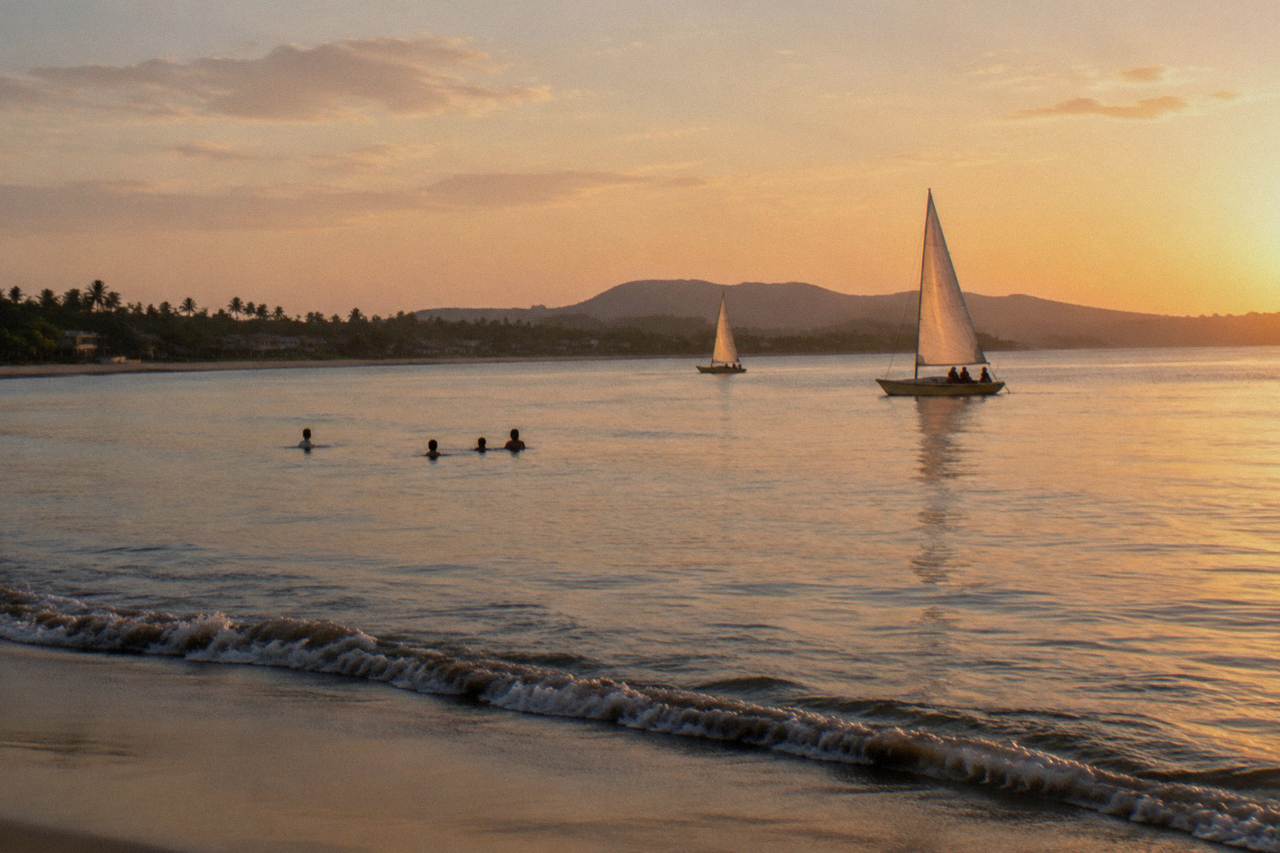
Sunset in Tamarindo falls between about 5:16 pm in mid November and about 6:08 pm in late June, a narrow tropical band, and every sunset cruise is timed to it. The astronomical tables for Tamarindo put late October sunset near 5:20 pm and mid February near 5:50 pm, both consistent with that range.
Because Tamarindo sits near 10 degrees north latitude, day length only swings between about 11 hours 30 minutes in December and 12 hours 43 minutes in June. The sunset clock moves slowly and predictably, per the astronomical tables for Tamarindo:
| Period | Sunset, about | What it means for the boat |
|---|---|---|
| Mid November | 5:20 pm | Earliest sunsets of the year |
| January | 5:40 pm | Dry season, crisp golden hour |
| Mid February | 5:50 pm | Driest month, late golden light |
| March to May | 5:55 pm | Latest dry-season sunsets |
| Mid July | 6:10 pm | Latest sunsets of the year |
| August | 6:00 pm | Green season with full-length evenings |
| Late October | 5:25 pm | Wettest month, early golden hour |
The operational detail behind the table: operator listings show typical sunset cruise departures between about 12:30 and 2:00 pm, which sounds early until you do the math. A 5-hour trip leaving at 1:00 pm in February gets a snorkel stop, lunch and a couple of hours of sailing before positioning for a 5:51 pm sunset, then docks in the dark. In June the same trip can stretch the daylight further.
Book the sunset slot in any month; the sky, not the calendar, does the rest. The Tamarindo sunset times guide carries the full month-by-month table and the physics behind the narrow band.
Is A Catamaran Cruise Still Worth It In The Rainy Season?
Yes, green-season catamaran trips in Tamarindo run regularly and often deliver the better sailing: cooler air, emptier decks, dramatic cloud and the warmest sea of the year in May. Rain mostly falls in afternoons and at night, morning departures dodge the worst of it, and every one of these listings shows free cancellation.
The case against green season collapses once you look at when the rain actually falls. The 30-year normals count monthly totals, not hourly patterns, and on this coast the classic green-season day is a sunny or bright-cloudy morning, a buildup through early afternoon, and a heavy evening shower. A morning nature sail leaving the beach in the 9 am hour is usually back before the sky opens. Sunset trips gamble more, but they also sail under the most photogenic clouds of the year, and a shower at sea in 28 C water is a story, not a disaster.
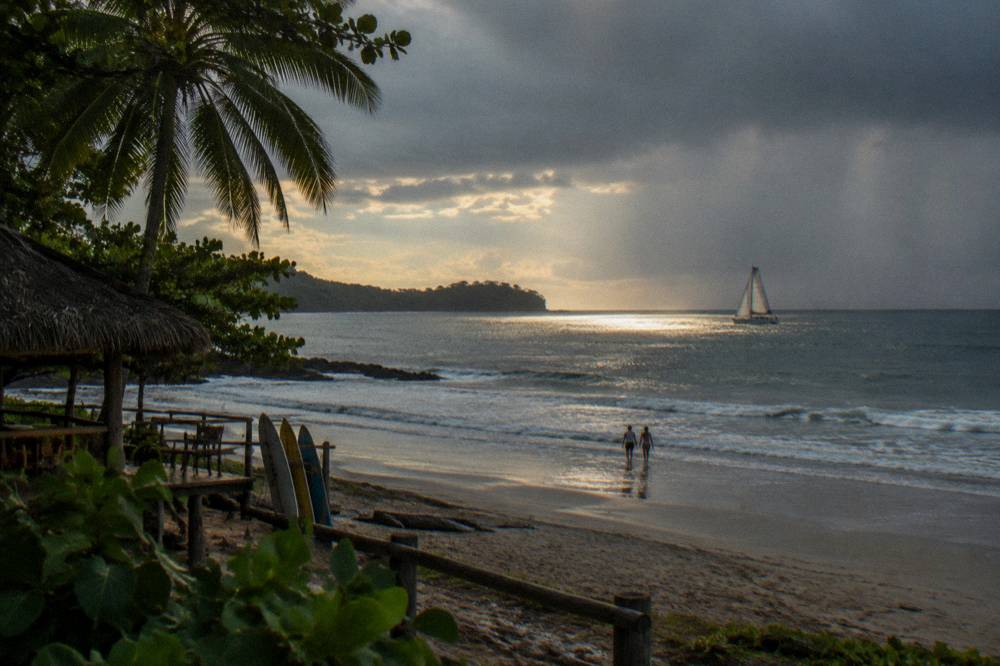
Crowds and price complete the argument. September and October are the quietest months on the water here, which means more room on the trampoline, no jostling at the snorkel ladder and easier last-minute bookings. Our boat tours in rainy season guide works through the whole trade in detail.
The morning option is where the green season shines brightest. A morning Flamingo departure like the one rated 5.0 from 44 reviews, with pickup listed from the Lazy Lizard Sailing area at Playa Flamingo, pairs the calmest water of the day with the driest hours, and the Playa Flamingo boat tours guide covers how those departures connect to Tamarindo stays.
How Do You Pick The Right Trip For Your Month?
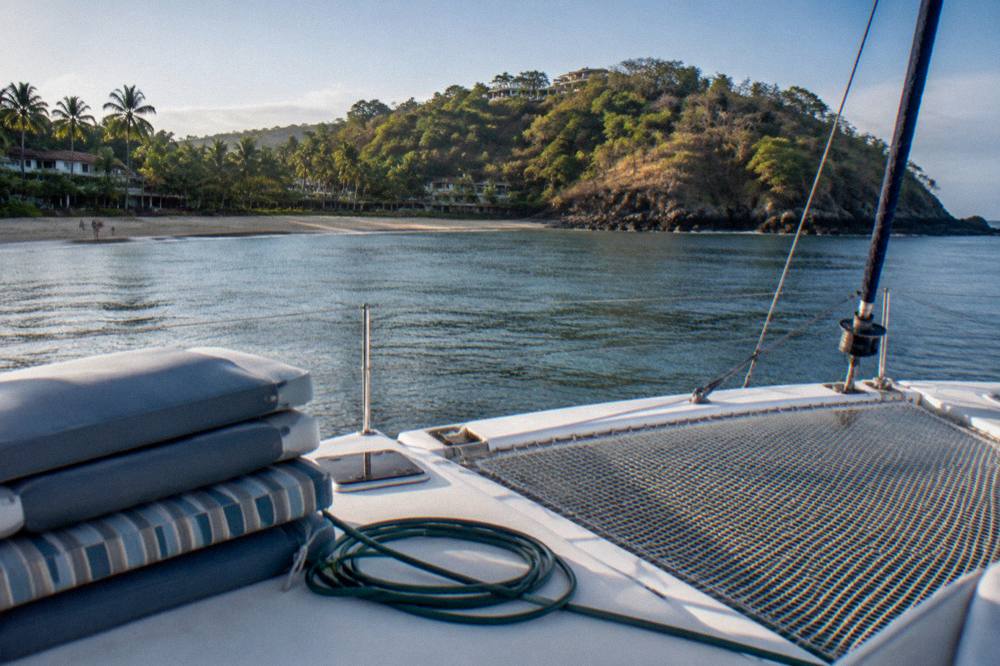
Match the trip format to the season rather than the brochure: morning snorkel sails for the windy dry months, flexible-with-cancellation sunset cruises for green season, and a private charter whenever the forecast is uncertain enough that you want control of the timing. These listings span shared sunset trips from $88 per person and private charters from $500 per group.
A simple decision table, using real trip prices:
| Your month | Best fit | Why |
|---|---|---|
| December to February | Morning day sail, 4 to 4.5 hours | Beats the afternoon Papagayo chop, uses the driest, clearest water |
| March to April | Either format | Wind eases, visibility holds, sea warms toward 29 C |
| May to August | Sunset cruise with free cancellation | Warmest sea, green-season quiet, rain risk is manageable |
| September to October | Morning sail, book close to the date | Wettest months; mornings give you the best odds |
| November | Sunset cruise | Rains taper, hills still green, crowds still thin |
The featured listing for this decision is the Timarouba Sunset Sail, Open Bar, from $97 per person for 5 hours, rated 4.5 from 504 reviews, departing the El Chiringuito area of Tamarindo beach with lunch, open bar, snorkel gear, two kayaks and a paddleboard listed. It is the balanced pick that works in almost any month, and free cancellation is listed. For a deeper field comparison, the Tamarindo boat tours compared guide lines up every listing side by side, and the trip picker on this site narrows it to your dates.
Whatever month you land on, the sea will be warm and a boat will be going out. The dry months sell certainty, the green months sell atmosphere, and on Tamarindo Catamaran Cruises we would rather you book the right week than the famous one.
Common Questions About Tamarindo Weather By Month
What is the rainiest month in Tamarindo?
October, averaging 354.1 mm of rain on 30-year normals, followed by September at 330.8 mm. Even then, much of the rain falls in afternoons and overnight, and catamaran trips keep running.
What is the driest month in Tamarindo?
February, averaging just 3.5 mm for the whole month, with January at 4.2 mm and March at 4.9 mm close behind. These are the classic high-season months.
Is the sea cold in Tamarindo at any time of year?
No. Monthly sea temperature averages run from about 27.3 C in January to 29.4 C in May. Swimming off the boat is comfortable in every month.
When is the wind strongest on the Tamarindo coast?
The Papagayo winds peak from December through March and commonly build after about 11 am. Morning departures are widely recommended in those months for the calmest sailing.
Can you snorkel in Tamarindo in the green season?
Yes, trips run throughout May to November, though operators report visibility of about 8 to 12 m or less versus 15 to 25 m in dry season. Boats target coves and the Catalina Islands rather than the often-cloudy open beach.
What time is sunset in Tamarindo?
Between about 5:16 pm in mid November and 6:08 pm in late June. Sunset cruises are scheduled around this narrow band, typically departing between about 12:30 and 2:00 pm.